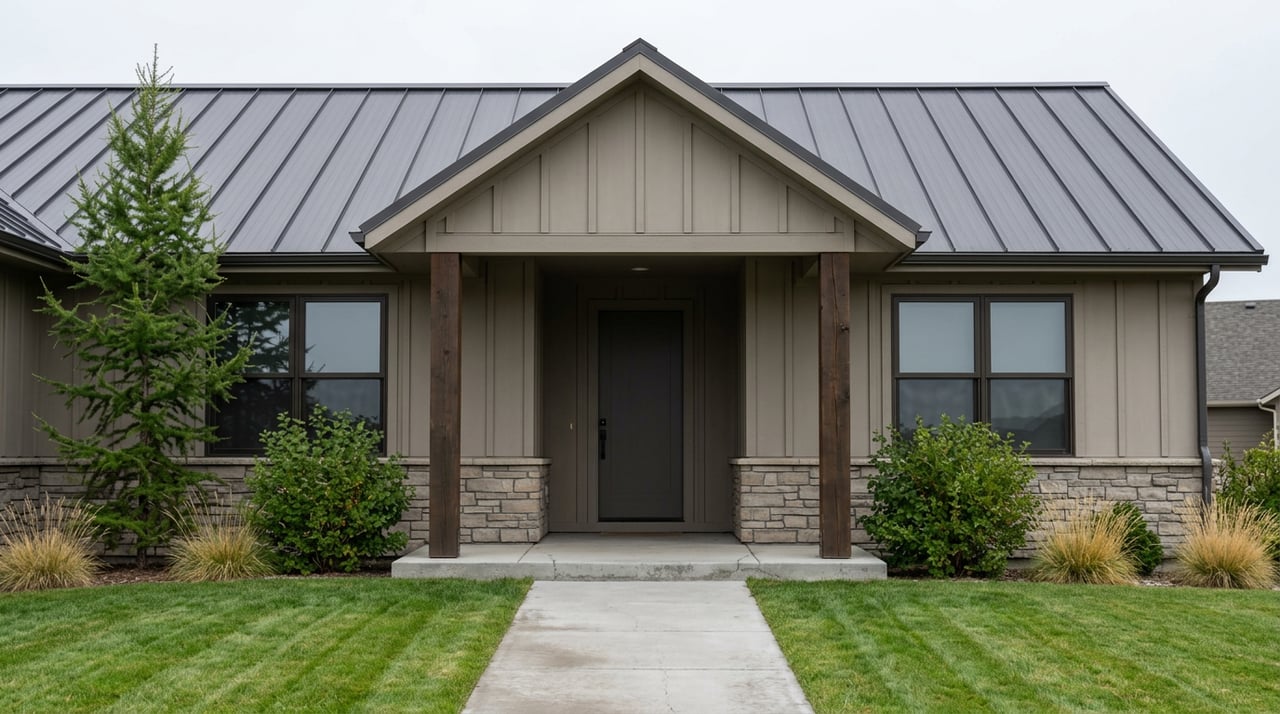
Kalispell MT Housing Market 2026: Two Trends to Watch
Open any real estate portal right now and search Kalispell. Depending on which one you land on, you will see the median sale price either down more than 11% year-over-year or up $25,000 from the prior year. Those figures aren't coming from different decades. They cover overlapping time windows from the same market. And if you're deciding whether to buy in Kalispell in 2026, which number you believe will shape your offer strategy, your timing, and whether you're reading the market correctly.
Both numbers are accurate. The tension between them is the story.
The Flathead Valley's housing market split at mid-2025 in a way that annual medians can't capture. According to January 2026 reporting by the Daily Inter Lake, homes priced under $1 million saw prices fall 4% in the second half of 2025, while homes over $1 million rose 10% over the same period. The divide tracked almost precisely along the line between primary residences and luxury second homes.
Kalispell sits almost entirely in the primary-residence category. Its full-year 2025 median, per the Northwest Montana Association of Realtors, landed at $560,000 — up from $535,000 in 2024. Whitefish, where the second-home buyer dominates, closed 2025 at a $996,000 median. The county-wide figure blends those two populations together. Pull them apart and the underlying forces become clear: the Kalispell sub-$1M market is under genuine softening pressure, while the segment that benchmarks against Whitefish is still tightening.
| Metric | Kalispell | Whitefish |
|---|---|---|
| 2025 Full-Year Median (NMAR) | $560,000 | $996,000 |
| H2 2025 Price Direction, sub-$1M | Down ~4% | — |
| H2 2025 Price Direction, over $1M | — | Up ~10% |
| Feb 2026 Median (Montana Regional MLS) | $552,500 | $1,300,000 |
| Primary buyer profile | Owner-occupant, local employment | Lifestyle, second-home, remote |
The short version: a buyer shopping Kalispell under $600,000 is operating in a softening primary-residence market with real negotiating room. A buyer with a budget above $1 million — whether in Kalispell's upper tier or looking at Whitefish — is competing against second-home demand that hasn't cooled.
The supply side tells the rest of this story, and it's specific to Kalispell in a way that doesn't apply elsewhere in the valley.
Between 2021 and 2025, Kalispell City Council approved roughly 7,500 new residential units. As of spring 2025, approximately 2,000 of those had been built, according to a city planning department growth update cited in January 2026 Daily Inter Lake reporting. The remaining 5,500-plus approved units are a slow-moving wave of future supply. Construction typically takes years to complete after a permit is issued, and 2025 alone saw 406 multi-family building permits filed in Kalispell — a jump from 128 in 2024, per the city's 2025 Construction, Subdivision and Annexation report.
The most visible piece of that pipeline came online in 2025: Parkline Towers, a 224-unit apartment complex on Kalispell's east end overlooking U.S. Highway 2. The Bloomstone subdivision, south of Glacier High School near Four Mile Drive, continues through its fifth and sixth phases, adding both single- and multi-family product to the south side of the city.
New rental supply is exerting specific pressure on the for-sale market. As apartments come online, some prospective buyers are choosing to rent instead, which expands active inventory and extends time on market for sellers. Kalispell's average days on market in March 2026 was 106 days, according to Montana Regional MLS data — down meaningfully from 155 days a year earlier, but still a market where sellers are waiting, not choosing.
The floor under this softness is the same thing that built the city's growth: sustained demand. Logan Health Medical Center and Flathead Valley Community College anchor a local employment base that doesn't disappear when mortgage rates tick up. Kalispell's population stood at just over 33,000 as of 2025. Buyers priced out of Whitefish at $996,000 don't evaporate — they recalibrate. That recalibration flow creates a demand ceiling on how far any correction in Kalispell's primary-residence market can run.
In January 2026, Kalispell's sale-to-list price ratio was 96.22%, and only 5.08% of homes sold above asking price — down from 14.04% the year before. Those are buyer-market numbers by any standard measure, and they have a direct translation at the negotiating table.
A 96% sale-to-list ratio means the average Kalispell seller closed roughly 4% below list price. On a $560,000 home, that's approximately $22,400 in negotiating room. That figure isn't a guarantee on every property — a well-priced home in a desirable location still moves faster and closer to ask — but it establishes the range most buyers in this market currently have access to.
The timing risk runs in the opposite direction from what most buyers expect. Montana Regional MLS data cited by the Flathead Beacon in March 2026 showed Kalispell's median rising from $505,000 in January to $552,500 in February. The spring and summer season historically compresses days on market and pushes prices upward, and agents across the valley are anticipating that pattern holds in 2026. Buyers who wait for summer to confirm the market is friendly may be entering at the moment the window closes. Mortgage rates briefly dropped below 6% for the first time since 2022 in late February before climbing back toward 6.5% — a reminder that financing costs shift faster than listing prices, and a $200 monthly payment swing can determine whether a buyer qualifies at all at the entry level.
The practical read: the wider negotiating spread belongs to Q1 and early Q2. That window narrows as summer approaches and the seasonal buyer pool deepens.
The roughly $436,000 spread between Kalispell's 2025 median and Whitefish's does more than illustrate affordability. It describes a demand pipeline that consistently refills Kalispell's buyer pool from above.
Whitefish's market in early 2026 is running on two speeds: competitive bidding on walkable downtown and ski-adjacent properties, and slower movement on pandemic-era inventory that was priced for a moment that has passed. Buyers who arrive in Whitefish expecting a single, legible market often find a more complicated set of products. Those who recalibrate toward Kalispell frequently find that $600,000 to $750,000 there buys a property — more square footage, a larger lot, proximity to the valley's healthcare and commercial employment base — that would cost $1.2 million or more in Whitefish.
That recalibration flow is part of what has kept Kalispell's median elevated relative to the softening in its sub-$1M tier. It also means Kalispell isn't simply a discount version of Whitefish. The buyer profiles are genuinely different: Kalispell draws primary-residence buyers embedded in the valley's economy; Whitefish draws lifestyle buyers whose first question is proximity to the mountain or the lake. Understanding which buyer you are — and which product actually serves your use case — is more useful than tracking either market's headline number in isolation.
Why do different sources show such different Kalispell median prices?
Different sources measure different things. The Northwest Montana Association of Realtors full-year 2025 figure ($560,000) averages all closed sales across twelve months. Month-specific figures reflect smaller samples, and winter transactions skew lower because fewer higher-end properties close in Q1. Neither number is wrong; they're answering different questions about the same market.
Does the multi-family supply pipeline affect single-family buyers?
Indirectly, yes. New apartments draw prospective buyers toward renting, which loosens competition for owner-occupied homes. The pipeline is heavily weighted toward multi-family, so single-family homes above $500,000 are more insulated from direct supply pressure than entry-level product. But the rental supply wave does affect days on market and the tone of negotiations across the board.
How should Kalispell sellers think about the current moment?
Sellers in the under-$500,000 tier face the most direct competition from new rental supply. Sellers in the $600,000-to-$900,000 range are more likely to attract buyers stepping down from the Whitefish market, particularly once spring buying season begins. Pricing strategy in this environment requires a property-level read, not a market-level assumption — the spread between well-positioned and over-priced listings is wider right now than it was in 2022 or 2023.
Tyree Real Estate works with buyers and sellers across the Flathead Valley who want market data interpreted, not just delivered. If you're sorting through what the Kalispell numbers mean for your specific situation — whether you're buying, selling, or trying to figure out where the market is headed this summer — reach out and let's work through it together.
Stay up to date on the latest real estate trends.

Lifestyle

At Tyree Real Estate, our experienced team is deeply committed to the Montana community and your real estate success. Let us help you find your perfect home today!